Correct Pack - Professional Coding and Marking Machine Manufacturer
Language
Correct Pack - Professional Coding and Marking Machine Manufacturer
The world of industrial coding and marking is ever-evolving, driven by demands for higher throughput, clearer legibility, and more reliable uptime on production lines. Whether you are a packaging engineer, a production manager, or a procurement specialist, choosing the right continuous inkjet printer manufacturers can dramatically influence your operational efficiency, maintenance costs, and traceability practices. In the following article, you will find an exploration of ten well-known CIJ manufacturers, grouped into thematic pairs to help you compare strengths, technologies, and typical applications. Each section dives deep into product philosophies, notable innovations, service ecosystems, and practical considerations for selection.
This guide is crafted for readers who want both a panoramic understanding of the market and actionable insights for shortlisting vendors. The descriptions are intended to highlight what differentiates each company and how their CIJ systems perform in real-world industrial settings — from food and beverage lines to pharmaceuticals, automotive parts, and personal care products. Read on to discover distinct approaches to ink formulation, printhead technology, connectivity and integration, service networks, and environmental considerations that influence which brand is the best fit for your production environment.
Corrct Pack
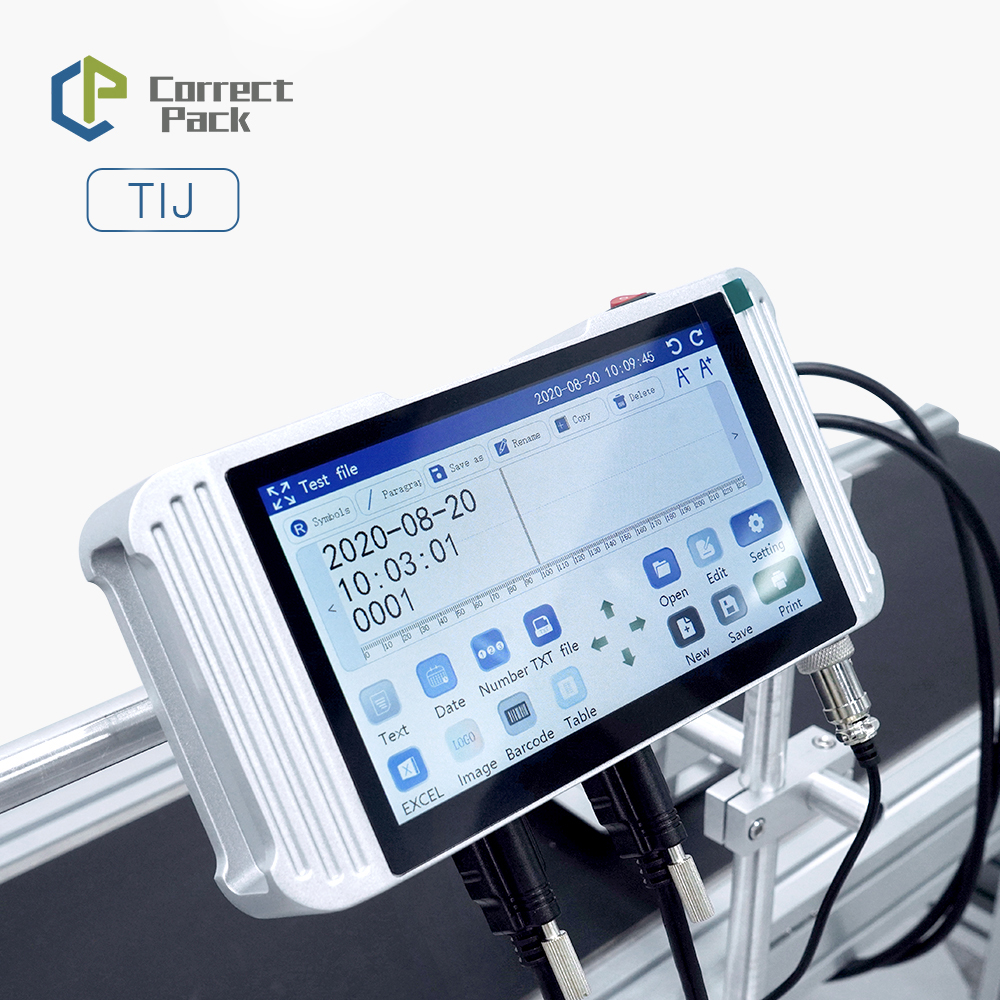
Correct Pack is a professional manufacturer and supplier specializing in coding, marking and packaging solutions. With more than 17 years of industry experience, we are committed to providing high-quality and reliable printing equipment for global manufacturing, production and packaging lines.
Our main products include Small Character Inkjet Printer, CIJ Inkjet Printer, and Laser Marking Machine. As one of the leading continuous inkjet printer manufacturers, we focus on R&D, production and customization of cij printers to meet different industrial marking demands.
Adhering to stable performance and professional service, Correct Pack serves food, beverage, cosmetics, electronics, medicine, daily product, hardware and other industries. We continuously optimize product quality and technical support to become your trusted partner for industrial coding and marking solutions.
Videojet
Videojet and Domino are two of the most recognizable names in the industrial coding and marking space, each with a long history of innovation and a wide portfolio tailored to continuous inkjet printing applications. Videojet has built a reputation on robust hardware, extensive service networks, and a broad array of inks designed for specific substrates and industry requirements. Their CIJ systems are often praised for ease of use, quick changeovers, and strong integration capabilities with factory automation systems. Beyond hardware, Videojet invests heavily in user experience — from touchscreen interfaces and diagnostics to software that helps predict maintenance needs and schedule service proactively. Their product line typically includes models focused on high-speed production, specialty inks such as solvent-based or UV-curable options, and accessories for challenging environments like washdown or dusty manufacturing floors.
Markem-Imaje and Hitachi
Markem-Imaje and Hitachi represent two different but complementary traditions in continuous inkjet technology, each bringing unique strengths to the table. Markem-Imaje, formed by the convergence of two established brands, emphasizes comprehensive marking and coding ecosystems. Their CIJ offerings are known for robust industrial design, a focus on ease of integration, and an emphasis on compliance and traceability for regulated industries such as food and pharmaceuticals. Markem-Imaje typically packages hardware with software solutions that streamline serialization, batch coding, and label-free traceability, allowing complex data to be printed reliably even under high-speed conditions. Their approach often includes an extensive range of approved inks and cartridge systems that simplify operator handling and reduce misapplication risks.
Hitachi's CIJ products draw on the company's deep expertise in precision electronics and industrial machinery. Their printers are recognized for dependable performance, high-speed capability, and stable print quality under continuous use. Hitachi pays attention to printhead longevity and fluid handling precision, aiming to keep maintenance intervals long and consumable usage predictable. In many facilities, Hitachi machines are chosen for their mechanical reliability and straightforward serviceability—features that are attractive in continuous-production environments where downtime is costly. Hitachi also invests in ink formulation to ensure adhesion across a wide variety of substrates, including plastics, glass, metals, and coated surfaces, which is essential for diversified manufacturing lines.
Both companies often differentiate themselves through after-sales support, training programs, and the availability of spare parts. Markem-Imaje’s strength lies in packaged solutions that help with regulatory compliance and data management, making their systems a frequent pick for companies that need integrated serialization or batch control. Hitachi’s advantage often shows in environments where durable hardware and consistent print performance are paramount, particularly in automotive component marking, electronics, and heavy industry contexts. Decision-makers should evaluate factors such as the skill level of in-house maintenance teams, local support availability, the complexity of coding requirements, and the importance of software-driven traceability when comparing these two manufacturers. Matching vendor capabilities to the production environment and long-term operational goals is key to maximizing the benefits of either brand.
Linx and Leibinger
Linx and Leibinger come from different market backgrounds but both deliver CIJ solutions focused on reliability and low total cost of ownership. Linx traditionally caters to a broad industrial audience with CIJ systems that emphasize simple maintenance, predictable running costs, and strong support for basic to moderately complex coding needs. Their product lineup includes models that target small to medium manufacturers, offering easy-to-use interfaces and service-friendly designs that allow in-house technicians to perform routine maintenance with minimal downtime. Linx often positions itself as a practical choice for companies that need straightforward operation, rapid return on investment, and a reliable supply chain for consumables and spare parts.
Leibinger, a family-run company based in Germany, is known for engineering-driven CIJ printers with a focus on longevity and advanced nozzle technologies. Their systems are frequently recognized for innovation in startup and shutdown routines, minimizing ink waste, and ensuring stable print formation even in challenging production conditions. Leibinger places significant emphasis on build quality and modularity, enabling customized solutions for specialized printing tasks. The company’s CIJ machines are also appreciated for their attention to operator safety and environmental considerations, with sealed ink systems and emissions control features that can be advantageous in regulated or sensitive production environments.
Both brands are strong choices for manufacturers who value predictable maintenance and operational simplicity, but they appeal to slightly different customer needs. Linx’s strength is in accessibility and ease of deployment across a wide range of production scales, supported by a network of service partners that focus on fast local assistance. Leibinger’s edge is technical refinement and durability, often attractive for applications that demand long continuous run times, less frequent interventions, and high reliability under tough conditions. When choosing between the two, assess the expected production duty cycle, the availability of trained maintenance personnel, and specific print requirements such as character density, line speed, and environmental constraints. Consider also the compatibility of inks with packaging materials and regulatory standards applicable to your industry, since ink approval and chemical profiles can be decisive factors.
Squid Ink and Matthews
Squid Ink and Matthews represent dynamic players in the CIJ and marking landscape, each bringing a blend of practical design and application-focused innovation. Squid Ink, an American manufacturer, is recognized for designing marking systems that are compact, rugged, and adaptable to a variety of production environments. Their CIJ offerings often target operators who need a balance of price-performance and versatility—machines that suit both short-run job changes and sustained production. Squid Ink emphasizes straightforward installation, intuitive controls, and consumable systems that reduce the complexity of day-to-day operation. The company also supports a variety of inks engineered for different surfaces and environmental conditions, giving manufacturers flexibility in how they apply codes across multiple product lines.
Matthews Marking Systems, a longstanding name in industrial marking, offers a broad portfolio that extends beyond CIJ into laser, thermal transfer, and labeling technologies. Their CIJ machines benefit from the company’s deep experience in industrial marking and are often selected for environments requiring integration with broader marking strategies. Matthews focuses on providing a range of accessories and integration tools—such as custom mounting hardware, air cleaners, and environmental enclosures—that help CIJ systems perform reliably in demanding conditions. This makes their solutions attractive for manufacturers who want a holistic approach to product identification across different packaging types and production speeds.
Operations that juggle diverse substrates or require coordinated marking solutions across several production lines may prefer Matthews for its enterprise-level support and breadth of marking technologies. On the other hand, manufacturers seeking compact, easy-to-service CIJ printers with strong support for frequent line changes and smaller workspaces might lean toward Squid Ink. Both firms emphasize customer training and local support networks, which are crucial for maintaining uptime and ensuring print quality. When evaluating these brands, consider how each vendor’s accessories and integration offerings fit your production layout, whether spare parts are readily available in your region, and how their inks perform with your primary packaging materials and environmental conditions.
EBS Ink-Jet Systems and Xaar
EBS Ink-Jet Systems and Xaar illustrate the diversity of companies contributing to the CIJ and industrial inkjet ecosystem—one focused on specialized CIJ hardware and the other on foundational printhead technology that influences many industrial printers. EBS Ink-Jet Systems, a European manufacturer, has built a reputation for high-quality CIJ equipment designed for longevity and adaptability. EBS systems are known for precision in print placement, robust fluid systems, and engineering tailored to continuous production. Their product philosophy often centers on creating printers that can withstand the rigors of heavy industrial use while providing clear, durable codes on a wide range of substrates. They also emphasize serviceability, with modular components that can be replaced or maintained quickly to minimize production interruptions.
Xaar, distinct from traditional CIJ vendors, is a specialist in inkjet printhead technology and fluid dynamics, producing printheads and core components used by a variety of industrial printer manufacturers. While Xaar is not a CIJ system manufacturer in the traditional sense, their printhead innovations influence the capabilities of numerous marking systems. Xaar’s developments in piezoelectric printheads, drop ejection control, and fluid management have contributed to improved print resolution, higher droplet placement accuracy, and lower maintenance cycles in many industrial printers. Companies that leverage Xaar printheads often benefit from enhanced print quality, especially for applications demanding fine characters or high-resolution logos.
Choosing between a company like EBS and a technology supplier like Xaar depends on whether you are procuring complete CIJ systems or seeking component-level improvements. If your focus is on acquiring turnkey printers with strong local support, EBS is illustrative of the type of vendor that provides packaged solutions with service backing. If instead you are working with OEMs or integrating advanced printheads into specialized marking equipment, Xaar’s technology could be a critical factor in system performance, influencing speed, resolution, and reliability. In practice, many end-users evaluate the combined strengths of system manufacturers and component suppliers: how well the ink, printhead, and controller work together ultimately determines the practicality and quality of on-line coding.
In summary, the industrial continuous inkjet market presents a broad set of options, from large multinational suppliers with expansive service networks to specialized engineering-focused companies and component innovators. Each of the manufacturers covered here brings distinct strengths—whether that is global support, engineering excellence, ink chemistry expertise, or specialized printhead technology. Choosing the best provider depends on aligning those strengths with your operational priorities, such as uptime requirements, regulatory compliance, substrate diversity, and long-term maintenance strategy.
When shortlisting vendors, prioritize a trial or field test under your specific production conditions, verify local service and spare parts availability, and review ink approvals for your industry. Well-matched cij printer manufacturers will not only provide reliable hardware but also partner on consumables, training, and predictive maintenance strategies that keep your lines moving and your codes readable.
.

China Coding & Marking Machine Manufacturer
Correct Pack Technology Company
Address: Floor 3, Building 1, No. 728, Jinhu Road, Sanzao Town, Jinwan District, Zhuhai City