Correct Pack - Professional Coding and Marking Machine Manufacturer
Language
Correct Pack - Professional Coding and Marking Machine Manufacturer
CO2 laser marking machines are rapidly becoming the preferred coding solution in the packaging industry due to their speed, low maintenance requirements, permanent marking capability, and consumable-free operation.
Compared with traditional ink-based coding systems, CO2 laser technology offers cleaner production, lower long-term operating costs, and highly reliable marking performance on materials such as paper, cardboard, plastic films, glass, and coated packaging surfaces.
In this article, we’ll explore why more manufacturers are adopting CO2 laser marking systems and which packaging applications benefit most from laser-based coding solutions.
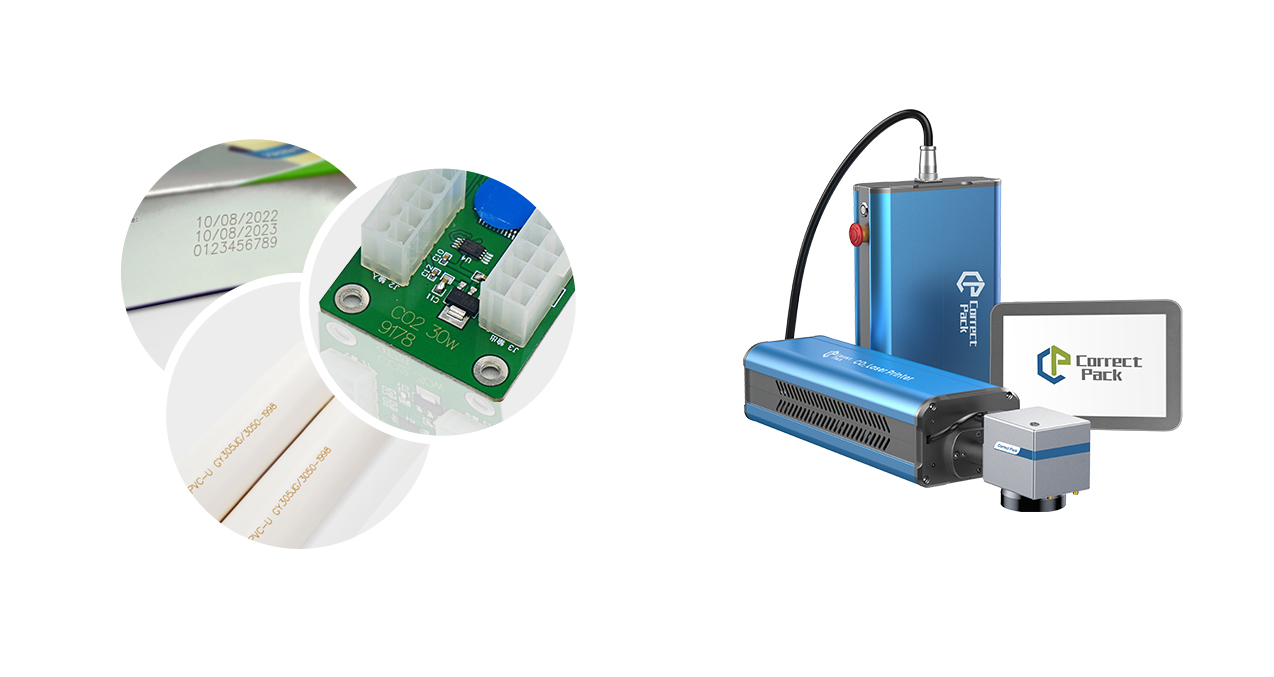
What is a CO2 Laser Marking Machine?
Let's start with the "what" before we get to the "why. The CO2 laser marking system is made up of a gas mixture (mainly CO2) to produce a laser beam. This particular kind of laser is ideal for "organic" materials. Consider materials such as wood, paper, glass, and most significantly, plastics used in food and medical products packaging.
As compared to a fiber laser that is ideal for metal, the CO2 laser is the king for non-metallic surfaces. It does not actually touch the product; it reacts with the surface of the package to leave a permanent mark.
Why Are CO2 Lasers Becoming Increasingly Popular?
With the birth of automation and strict labelling regulations, manufacturers have been forced to invest in upgrading their marking systems. The CO2 laser marking machine is remarkable for its ability to address several issues simultaneously.
1. No More Buying Consumables
In the past, printing codes on 10,000 boxes meant having to purchase 10,000 labels or liters of ink and solvent. And when the ink ran out, the production line stopped.
The "fuel" in a CO2 laser marking machine is electricity. No fluid storage or expensive fluids to recycle, no ribbon change, no ink cartridge change. For the laser marking machine manufacturer, this is a real game-changer, because they can provide a solution that pays off in just a year or two.
● No Ink: No spills, no stains, no chemical smell in the factory.
● No Labels: No corners to peel or paper to waste.
● Reduced Maintenance: Lasers don't have heads that clog up the way ink jet printers do.
2. High-Speed Production for Modern Factories
In the packaging world, time is money. With a conveyor belt operating at 200 meters per minute, you will need a marking system that can match.
A good quality CO₂ laser marking machine is designed for high-speed production lines. It can “fire” pulse fast enough to highlight sharp, clear text in the midst of zooming past the product. The laser doesn't slow down, no matter what it's marking, from a bottle of soda to a pouch of IV fluid.
Pro Tip: Look for systems like the CO2 Laser Marking Machine-CP6030C. It’s designed specifically to integrate into existing lines without slowing them down.
3. Permanent Marks That Can’t Be Erased
Have you ever purchased a product that didn't have a clearly marked "Best Before" date? This is a major issue for safety and brand integrity. Alcohol or even shipping friction is enough to rub off ink.
That's not the case with laser marking. It alters the surface of the material. It is:
● Waterproof: It will not be washed away in a moist fridge.
● Tamper-proof: You can't rub it out and re- write the date.
● Scuff-resistant: It remains clear from factory to kitchen.
4. Better for the Environment
Sustainability is more than a trend: it is a necessity for lots of modern enterprises. Traditional inkjet printing involves solvents that emit VOCs (volatile organic compounds) into the air. These can be toxic to workers and the environment.
Since a CO2 laser marking machine doesn't require any chemicals, it's a much "greener" choice. It minimizes the carbon footprint of packaging by significantly cutting down on the waste of unused ink cans and the backing paper used on the labels themselves.
5. Clear QR Codes and Traceability
In the modern packaging, clear coding is very important. A co2 laser marking machine can generate clear QR codes and barcodes, which can be scanned quickly even at a high speed.
This aids companies to maintain track of merchandise from manufacturing to delivery. It's essential for safety and recalls in industries such as food and pharmaceuticals. Every code is clear and permanent when using a CO2 laser marking system.
The other advantage is the longevity. Codes will not fade or smudge. They remain legibly accessible even after handling, heat and moisture. This gives them the ability to be used for long supply chains and long shelf life.
6. Low Maintenance and High Reliability
Production lines cannot afford frequent downtimes. A CO2 laser marking machine can help prevent this by operating efficiently without the problems that often occur with marking machines such as ink leakage or clogging.
There are no consumables, making maintenance easy and infrequent. A CO2 laser marking system is designed to operate for extended periods of time with a stable performance.
This reliability means that downtime and repair costs are reduced. It supports businesses in the long run to avoid discontinuous production.

Why Flexible Packaging Loves CO2 Lasers
Flexible packaging such as bags for salads, snacks or frozen goods is one of the most difficult to print. It is thin and tends to be slippery. Sometimes ink doesn't adhere to it.
But a CO2 laser might "color change" the plastic film or peel a small amount of the surface color to expose a different color. This creates extremely fast scanning QR codes that can be scanned by any smartphone. This is essential for "track and trace" systems in the pharmaceutical and food industry.
Research on sustainable packaging trends indicates that transitioning to digital and laser packaging is one of the quickest ways to enhance supply chain efficiency.
Recommended Industries for Laser Marking
This type of technology may be applicable to virtually any business, but four specific sectors are leading the way:
1. Food Packaging
Whether it's egg cartons or bread bags, the primary concern is food safety. Lasers are non-contact and do not need any ink, so there is no risk of the ink leaking into the food.
2. Beverages
CO2 lasers work well on glass bottles and PET plastic bottles. The laser can print with high accuracy on the neck of the bottle or the cap, even if the bottle is wet from condensation.
3. Pharmaceuticals
Clear, permanent serial numbers are necessary for medicines to prevent counterfeiting. The CO2 laser marking system offers high resolution, perfect for small text, which is needed for small pill bottles or blister packs.
4. Flexible Packaging
For pouches and films, the laser offers a clean alternative to thermal transfer printing, which often requires expensive ribbons.
Choosing the Right Manufacturer
Selecting the right laser marking machine manufacturer is a very important decision. The support must be good; otherwise, the machine is not good.
Experience is the first thing to consider. A company which knows packaging knows how to deal with different materials and speed. This is important because CO₂ lasers work best when properly tuned to packaging materials such as plastic and paper .
Second, keep in mind reliability. A good co2 laser marking machine should be able to operate continuously for extended periods of time. Laser systems are renowned for their low maintenance and low costs as they don't require ink or consumables.
Third, check support. A good manufacturer will provide installation assistance, training and prompt service. This means that your production won't be interrupted.
Now about the company. Correct Pack is a well-known name in coding and marking solutions. As a trusted laser marking machine manufacturer, the company focuses on practical solutions for packaging industries.
The Evolution of QR Codes and Data Matrix
Packaging has become 'smart' in the 2020s. Brands want to add QR codes to make it easy for consumers to find out where their food is coming from or participate in a contest.
A small, intricate QR code may not be correctly printed on a curved surface using an inkjet printer. The code will not work if there is running of ink on one of the dots. A CO2 laser marking machine is very accurate. It can perfectly engrave a Data Matrix code which is 10mm x 10mm and is easily readable by scanners, every time.
Final Thoughts
As packaging manufacturers continue to prioritize efficiency, sustainability, and production reliability, CO2 laser marking machines are becoming an increasingly attractive alternative to traditional ink-based coding systems.
Their ability to deliver permanent, high-speed, and consumable-free marking makes them especially valuable for modern packaging environments requiring low maintenance, reduced downtime, and improved traceability.
With ongoing advancements in laser technology and growing demand for cleaner production processes, CO2 laser marking systems are expected to play an even larger role in the future of industrial packaging and product identification. If you want to see this technology in action, check out the CO2 Laser Marking Machine-CP6030C. It’s a great example of how a laser marking machine manufacturer can combine speed with precision to make your packaging line run.
Science and technology oriented, continuous improvement, Correct Pack always committed to providing customers with valuable products and satisfy services

China Coding & Marking Machine Manufacturer
Correct Pack Technology Company
Address: Floor 3, Building 1, No. 728, Jinhu Road, Sanzao Town, Jinwan District, Zhuhai City

