Correct Pack - Professional Coding and Marking Machine Manufacturer
Language
Correct Pack - Professional Coding and Marking Machine Manufacturer
If we have food on our plates providing us with nourishment and energy, Ensuring product safety and transparency is essential for protecting consumers.In the food industry, proper coding and marking are essential for maintaining safety, traceability, and compliance. Every product needs clear information, such as expiration dates, batch numbers, and barcodes, to ensure consumers know what they are buying and to help manufacturers track products throughout the supply chain.
Ensuring product safety and transparency is an indispensable aspect of facilitating public welfare. Continuous inkjet printers play a pivotal role in disclosing product information to buyers and are an integral part of product packaging in this sector.
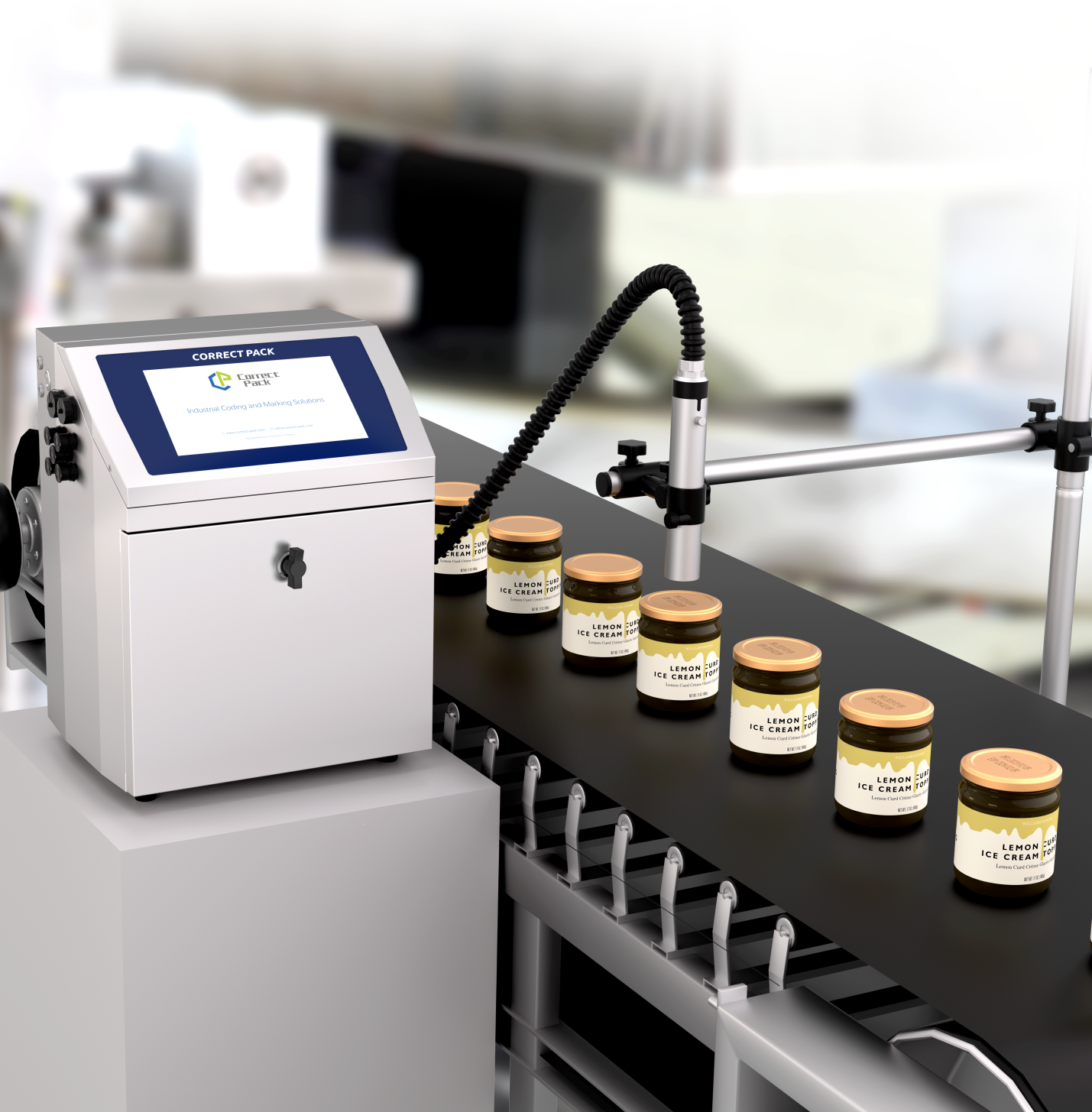
Continuous Inkjet (CIJ) printing is the best choice for today’s fast food production. It provides quick, accurate, and affordable printing on various packaging materials. This includes plastic bottles, metal cans, and cartons. Every code comes out sharp, clear, and dependable.
How does a CIJ printer work?
CIJ is short for continuous inkjet. In a CIJ printer, the system pumps ink from an ink reservoir and ejects it through a nozzle that creates a jet of ink. The jet of ink is then broken up into a large number of ink droplets through high-frequency vibration. Once the droplets are formed, select droplets are charged by electrodes. The stream of droplets passes through deflector plates. These plates create an electrostatic field.
The charged drops are deflected as they move through the deflector plates to be ejected from the print head and placed on the product to form the required message. Uncharged drops are not deflected and return to the CIJ ink system.
Through this printing process, the solvent base of the ink will evaporate, changing the ink’s viscosity. To ensure the optimum drop formulation, the viscosity must be tightly controlled to a defined value.
CIJ printers have a built-in viscometer to continually measure the ink viscosity. The printer automatically adds solvent to the ink. This keeps the viscosity level just right at all times.
Why Continuous Inkjet Printers Are Ideal for Food and Beverage Packaging?
1. It Keeps Up With The Line
Even when products are flying down the conveyor, CIJ printers don’t miss a beat. Batch codes, dates, and serial numbers stay crisp and readable.
2. Simple To Operate
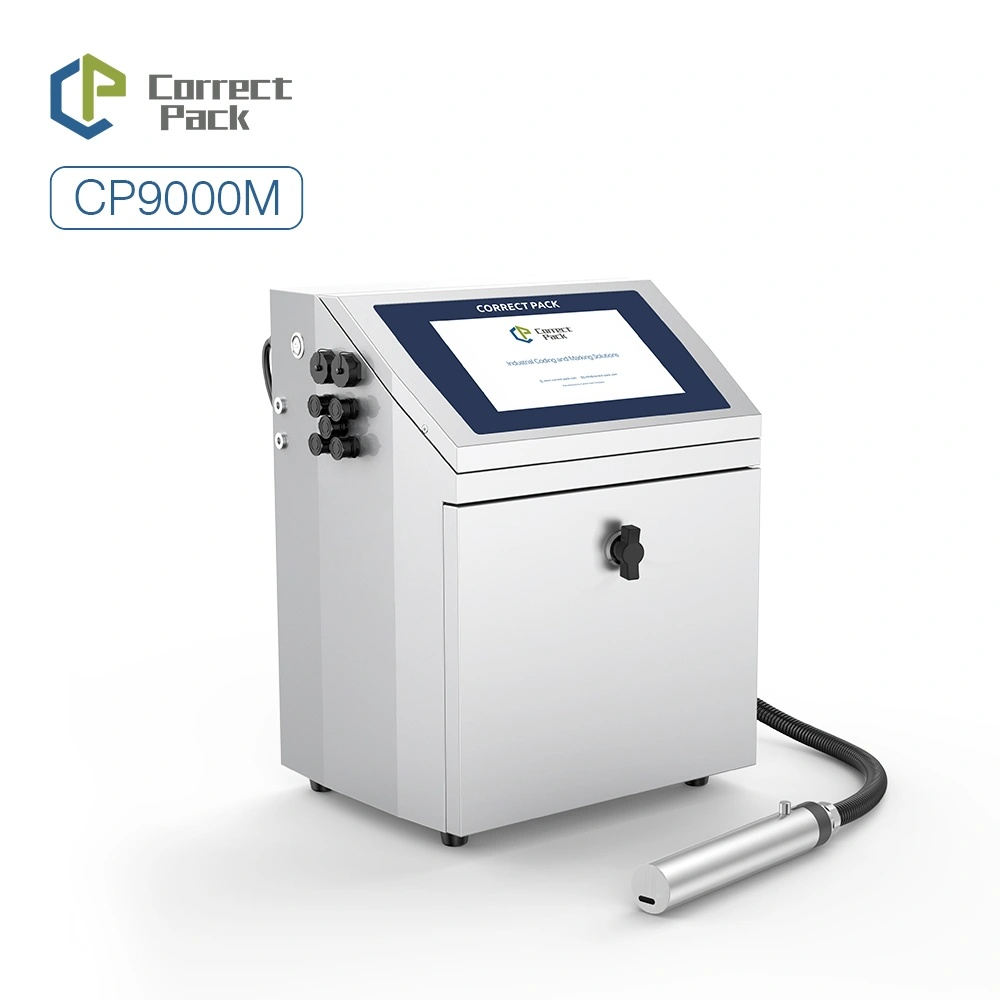
Nobody wants a complicated machine in the middle of a busy shift. The CP9000’s touch-screen interface is easy to use, messages can be edited quickly, and maintenance is minimal. It is designed to simplify daily operation.
3. Consistent Print Quality
Whether it’s glass, plastic, or cardboard, the results stay sharp. The prints don’t fade or smear, exactly what’s needed for clear identification and quality control.
4. Automatic Printhead Cleaning
Auto-cleaning printheads and stable ink circulation mean fewer interruptions. Less maintenance equals more production time and better efficiency.
5. Fits Almost Any Industry
From food and beverages to cosmetics, cables, or construction materials — CIJ printers adapt easily to different production setups.
Key Considerations for Selecting CIJ Printers for Food Packaging
● High-quality coding – You can get high-quality date, MRP, and batch code prints. These are necessary for every business, and you can get the printing done on many types of materials, including plastics and cable wires.
● Low running costs – With the low cost of ownership and minimal maintenance, our CIJ printers are ideal for all industries that are looking to cut down on their costs.
● User-friendly operation – We have worked on making our CIJ printers easy to use with a touch screen so that anyone can operate them easily. without any issues. The user interface ensures that the printing errors are reduced.
● Minimal downtime – The robust built quality of Correct Pack F500 Series printers is worth relying on, and a reliable product minimizes downtime. Along with it, you get more general to ensure that your printers never stop running. Our highly skilled service engineers deliver prompt service. With a wide range of consumables, you’ll never feel restricted with the inks to print onto your products.
CIJ vs. Other Printing Technologies
Every printing method has its place, but for speed, flexibility, and cost efficiency, CIJ stands ahead.
| Feature | CIJ Printer | Laser Printer | TIJ Printer |
| Speed | High | High | Moderate |
| Material Range | Almost Any | Limited | Mostly Porous |
| Maintenance | Low | Moderate | Low |
| Color Options | Many | Limited | Limited |
| Cost for High Volume | Low | Higher Setup Cost | Moderate |
Laser printers are excellent for permanent marks, but usually cost more and need special safety setups. CIJ printers offer a wider range of materials, quicker startup, and simpler upkeep — perfect for busy production environments.
Applications of CIJ printers in the Food and Beverage Sector
Have a look at the various applications of continuous inkjet printers in the food and beverage industry and the types of packaging for which CIJ printers can be used.
Printing Date Codes On Packages
Ingesting expired food products can cause food-borne illnesses and should be avoided. Date code printing involves specifying the date of manufacture and expiry in every product. The FDA guidelines emphasize date codes as an highly crucial packaging process to ensure that consumers are aware of the product’s shelf life. Such transparency also prevents sellers from offering expired, unhealthy products in the market.
Specifying Batch Numbers
Batch numbers essentially help buyers identify a set of products that share certain common features, such as date of manufacture, expiry date, and identification code. Understanding the batch to which a product belongs can help identify the manufacturer and packaging history of the product in case of any defects or issues. Continuous inkjet printers are widely used to print batch numbers during the primary as well as secondary packaging stages.
Maximum Retail Price
Price is perhaps the first piece of information that buyers look for in packaged and ready-to-eat goods. CIJ printers are used to display the MRPs of products clearly on the packaging. Providing the MRP on the product’s covering can help consumers know the value of food and beverage products they are purchasing and avoid being exploited in the market.
Printing QR Codes
CIJ printers can print QR codes, which can be scanned to complete the authentication of the product, ensuring that it is genuine and not duplicated.
Printing GS1 DataMatrix Codes
Continuous inkjet printers are also used to print GS1 Datamatrix codes, which are mandatory on primary products today. Continuous inkjet printers can be used to print product details on cans, plastic bottles, cardboard containers, and even delicate surfaces like eggshells. Its quick-drying, non-contact printing process and efficient printing speed have facilitated its popularity in various sectors, including food and beverage.
Conclusion
Continuous Inkjet Printers are perfect for food and beverage packaging. They offer high-speed printing and low maintenance. These printers work on various substrates and are cost-effective. Plus, they come with advanced features. These printers provide many benefits. They help businesses meet their printing needs on time. This can boost productivity and increase profits. CIJ printers can print on many surfaces. This gives food and beverage makers a flexible and dependable solution. It helps them meet the needs of today’s competitive market.
CIJ printers deliver sharp, high-quality prints. They work well for end dates, lot codes, barcodes, and more. This consistency helps businesses build a strong brand and keep consumers safe. Continuous Inkjet Printers help food and beverage packaging companies improve their printing. This technology keeps them competitive in a fast-changing industry. Contact Correct Pack for Best CIJ Printer.
Science and technology oriented, continuous improvement, Correct Pack always committed to providing customers with valuable products and satisfy services

China Coding & Marking Machine Manufacturer
Correct Pack Technology Company
Address: Floor 3, Building 1, No. 728, Jinhu Road, Sanzao Town, Jinwan District, Zhuhai City