Case Study
Correct Pack - Professional Coding and Marking Machine Manufacturer
Language
Correct Pack - Professional Coding and Marking Machine Manufacturer
High‑speed packaging lines simply can't afford coding errors. A blurry batch number or an illegible expiration date could mean delayed shipments, hefty regulatory fines, or even a supply‑chain meltdown. Continuous inkjet (CIJ) printing offers a straightforward fix — it applies non‑contact, quick‑drying codes to virtually any surface, so it neatly sidesteps the problem. In this article, we’ll walk you through how CIJ works, why it’s worth considering, and how to pick the right setup for your specific line.
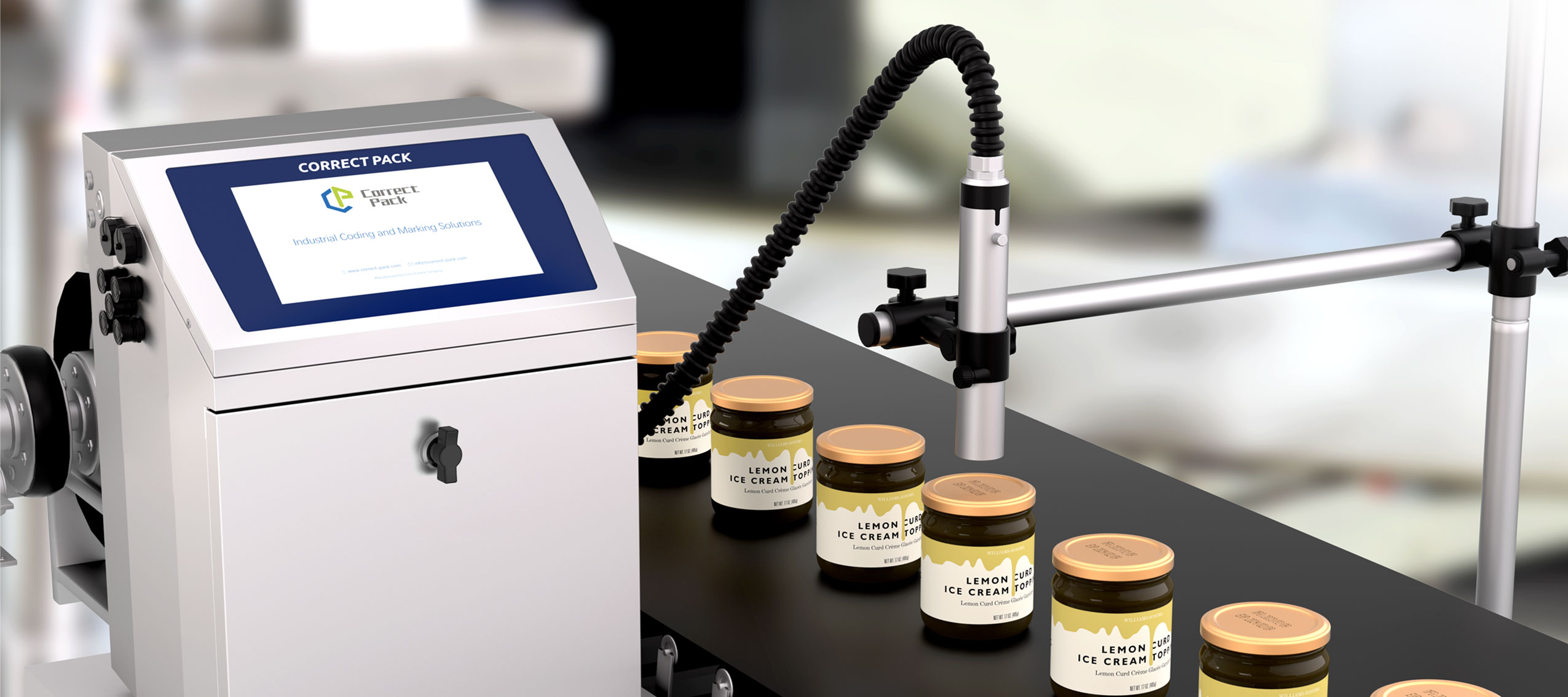
What Is Continuous Inkjet (CIJ) Printing Technology?
CIJ printing is a non-contact industrial coding method. Its primary design target? High-speed variable data coding. That alone sets it apart from the office inkjet printers you might be familiar with—those release ink only when required, a technique known as Drop-on-Demand, or DOD. CIJ operates differently: a continuous, unbroken stream of droplets flows throughout the process.
The practical job of this technology is straightforward. As products move down a conveyor line, CIJ applies quick-drying marks—expiration dates, production times, batch numbers, barcodes, and logos—directly onto them. Because the printhead never physically touches the substrate, you can run these printers on surfaces that are flat, curved, textured, or even irregular. They don't jostle the product, and they don't sacrifice clarity or consistency.
Key Components of a CIJ System
A standard industrial CIJ printer consists of several integrated subsystems:
• Fluid System: Holds the ink and make-up fluid (solvent), maintaining proper ink viscosity and pressure.
• Printhead: Houses the piezoelectric oscillator, nozzle, charge electrode, deflection plates, and gutter.
• Electronic Control Unit: Processes print data, regulates timing, and controls electrical charges applied to individual ink droplets.
How Does a Continuous Inkjet Printer Work?
Understanding the inner workings of a CIJ printer highlights why it is uniquely suited for demanding factory environments. The process relies on fluid dynamics, piezoelectric vibration, and electrostatics.
Here is a step-by-step breakdown of the continuous inkjet printing cycle:
1. Pressurized Ink Flow: Ink is pumped under high pressure from the fluid reservoir to the printhead nozzle, which features a minute opening (typically between 40 and 70 microns in diameter).
2. Droplet Formation: Inside the printhead, a piezoelectric oscillator vibrates tens of thousands of times per second (usually 60 to 120 kHz). This vibration breaks the continuous stream of liquid ink into precise, uniform droplets.
3. Electrostatic Charging: As droplets form, they pass through a charge electrode. Droplets intended to form characters on the substrate receive an electrical charge. The level of charge varies depending on where the droplets need to land within the vertical matrix of a character.
4. Electrostatic Deflection: The charged droplets then pass between two electrostatic deflection plates, which generate a high-voltage electrostatic field. The electric field deflects charged droplets in proportion to their charge level, directing them onto the substrate moving beneath the printhead.
5. Ink Recycling (The Gutter): Uncharged droplets pass through the deflection field completely straight without bending. They land inside a collection gutter at the front of the printhead, where a vacuum pump pulls them back into the main fluid reservoir to be reused.
This closed-loop circulation system ensures minimal ink waste and enables continuous operation without frequent stopping.
Advantages and Limitations of Continuous Inkjet Printing
Like any industrial marking solution, CIJ technology presents distinct advantages and operational limits. Evaluating both helps manufacturers determine if CIJ aligns with their production constraints.
Advantages of CIJ Printing
• Extremely High Printing Speed: CIJ printers can mark lines running at speeds up to 300+ meters per minute, making them ideal for high-throughput automated packaging lines.
• Non-Contact Capability: The distance between the printhead and the product (throw distance) can range from 10 mm to over 20 mm. This permits printing on uneven, concave, flexible, or fragile surfaces.
• Fast-Drying Inks: CIJ systems utilize solvent-based inks (such as MEK, ethanol, or acetone) that dry within seconds, preventing smearing on non-porous materials like plastic, glass, and metal.
• Continuous Operational Uptime: Because the ink flows continuously, nozzle clogging during production runs is significantly reduced compared to stationary inkjet systems.
Limitations of CIJ Printing
• Print Resolution Boundaries: CIJ printers typically produce dot-matrix characters (e.g., 5x5, 7x9, or 16x16 matrices). While clear and readable, the resolution (around 100 DPI) is lower than high-definition thermal inkjet (TIJ) printing.
• Solvent Consumption and Odor: Solvent-based inks evaporate over time, requiring make-up fluid replenishment and proper ventilation in sensitive packaging areas.
• Routine Maintenance Requirements: Fluid filters, pumps, and printhead gutters require regular cleaning and periodic maintenance to ensure stable viscosity and prevent fluid contamination.
Common Applications of CIJ Printing Technology
Thanks to its compatibility with diverse substrate materials and high-speed resilience, CIJ technology is widely deployed across global manufacturing sectors.
Food and Beverage Packaging
CIJ printers cover a lot of ground here. Flexible film pouches, PET bottles, glass jars, aluminum cans, and corrugated cartons—all get production dates, best‑before dates, and lot numbers from these machines. The inks dry quickly and resist moisture. Even in wet packaging environments, legibility holds up.
Pharmaceuticals and Medical Devices
Traceability regulations in pharma are strict. Production lines turn to CIJ systems for batch numbers, 2D DataMatrix codes, and expiration dates. The targets? Blister packs, medicine vials, carton boxes, and plastic bottles. Each mark has to be clear and permanent.
Cable, Wire, and Extrusion Manufacturing
Pipes and wires run at high linear speeds, non‑stop. That continuous movement calls for CIJ printers to apply meter markings, brand logos, and specifications onto PVC, HDPE, rubber, or metal tubing. Dark surfaces often require pigmented inks—white or yellow, for instance—to get the contrast needed for readability.
Cosmetics and Personal Care
Curved containers and smooth materials are the norm in personal care. Glass perfume bottles, plastic lotion tubes, shampoo caps—CIJ handles them all without contact. That means discreet batch codes can be applied without marring the look. And the inks are formulated to resist oils and liquids, which is essential in cosmetics.
What Factors Affect CIJ Printing Performance?
To maintain sharp, readable codes day in and day out on an automated packaging line, several interrelated operational factors must be monitored and controlled continuously.
Ink Viscosity and Temperature Control
Ink viscosity directly dictates droplet formation quality and electrostatic charging precision. Temperature shifts inside a factory can thin or thicken solvent inks rapidly. If viscosity drops too low, ink droplets become erratic, resulting in blurry text. Industrial CIJ printers prevent this by using internal viscometers that automatically dose make-up fluid to maintain fluid stability.
Throw Distance Management
Although non-contact printing offers exceptional versatility, the distance between the printhead and the target substrate directly impacts character placement. Increasing throw distance beyond the recommended 10 mm to 15 mm subjects flying droplets to ambient air currents. This air turbulence causes individual droplets to drift, producing distorted characters, fuzzy edges, or misaligned dot matrices.
Line Speed and Encoder Synchronization
Conveyor speeds rarely stay perfectly constant during factory operation. Motor speeds fluctuate during line acceleration, slowdowns, or product loading. Integrating a rotary shaft encoder translates physical conveyor movement into precise electrical pulses, allowing the printer to dynamically adjust droplet deflection timing so code width remains uniform regardless of line speed variations.
Substrate Energy and Surface Condition
The physical and chemical state of a target surface dictates ink droplets adhesion. Low surface energy plastics, dust, oily residues, or moisture condensation prevent ink droplets from bonding cleanly. This can lead to ink bead-up or severe smearing during packaging. Selecting ink formulations tailored to specific substrate properties resolves adhesion issues.
How to Choose the Right CIJ Printer for Your Business

When you're choosing an industrial continuous inkjet printer, it's all about matching your line specs to your long-term goals. Here are a few things to weigh during your evaluation:
1. Line Speed Requirements: Check the printer's maximum character generation rate. It needs to beat your fastest line speed, especially if you're printing multi-line text or dense barcodes.
2. Substrate Material and Ink Compatibility: Think about what you mark most often. Will you use standard dye-based black inks, food-grade inks, high-contrast pigmented ones, or UV-curable formulations? That depends on your material.
3. Operating Environment: If your facility sees washdowns, high humidity, or lots of dust like in food processing or construction material plants, go for printers with IP65 or IP66 stainless steel enclosures.
4. Total Cost of Ownership (TCO): Don't just look at the purchase price. Think about solvent consumption, how often filters need replacing, spare parts availability, and how easy the printhead is to maintain.
5. User Interface and Integration Capability: Modern production lines work best with intuitive touchscreen interfaces, automated code templates, and flexible connectivity options like Ethernet, RS232, and I/O ports. That makes it easy to hook into PLCs, ERP systems, or packaging machinery.
Final Thoughts
Continuous Inkjet (CIJ) printing remains the industry standard for high-speed, non-contact product coding. Matching system capabilities with your facility's line speed, materials, and operating environment ensures reliable daily output and full batch traceability.
With decades of experience in coding technology, Correct Pack builds high-performance Continuous Inkjet printers designed for stable fluid management, precise ink droplet control, and minimal maintenance. Our robust CIJ printers deliver crisp, fast-drying codes on even the fastest packaging lines. Contact us today to discover the ideal CIJ printing solution for your line.
Science and technology oriented, continuous improvement, Correct Pack always committed to providing customers with valuable products and satisfy services

China Coding & Marking Machine Manufacturer
Correct Pack Technology Company
Address: Floor 3, Building 1, No. 728, Jinhu Road, Sanzao Town, Jinwan District, Zhuhai City